
Projects
2019 · Banff Centre for Arts and Creativity
Banff, Alberta, Canada
Created as an experimental multimedia collaboration between myself and Elder Lloyd “Buddy” Wesley — musician, storyteller, and tribal historian of the Stoney Nakoda Nation — the residency explored reconciliation as lived relationship.

For one month, Elder Lloyd “Buddy” Wesley — a musician, storyteller and tribal historian of the Stoney Nakoda Nation — and I worked together through painting, music, conversation and language.
Calls for dialogue and mutual understanding can sound generous, while leaving unequal distributions of power, resources and authority untouched. They can ask Indigenous people to share their knowledge, revisit painful histories and extend trust, without requiring comparable change from the institutions making the invitation.
I wanted to understand what reconciliation might demand of me beyond agreeing with it—and whether our encounter could make room for disagreement without turning it into a reassuring story.

What happens when two people risk knowing one another?

The residency grew from a long-standing collaboration with artist and arts administrator Dawn Saunders-Dahl. Working under the tongue-in-cheek name We Need a Better Name, we’d spent years exploring questions of identity and place through conversation and public art.
Following the Bow River through the Rocky Mountains, our attention turned toward the histories of meeting, trade and exchange that long predate Canada. We began asking how public art might help reopen connections narrowed by separation, stereotype and historical trauma.
Dawn often speaks of reconciliation as a willingness to make a friend for life.

Our working process was simple, but its consequences were unpredictable.
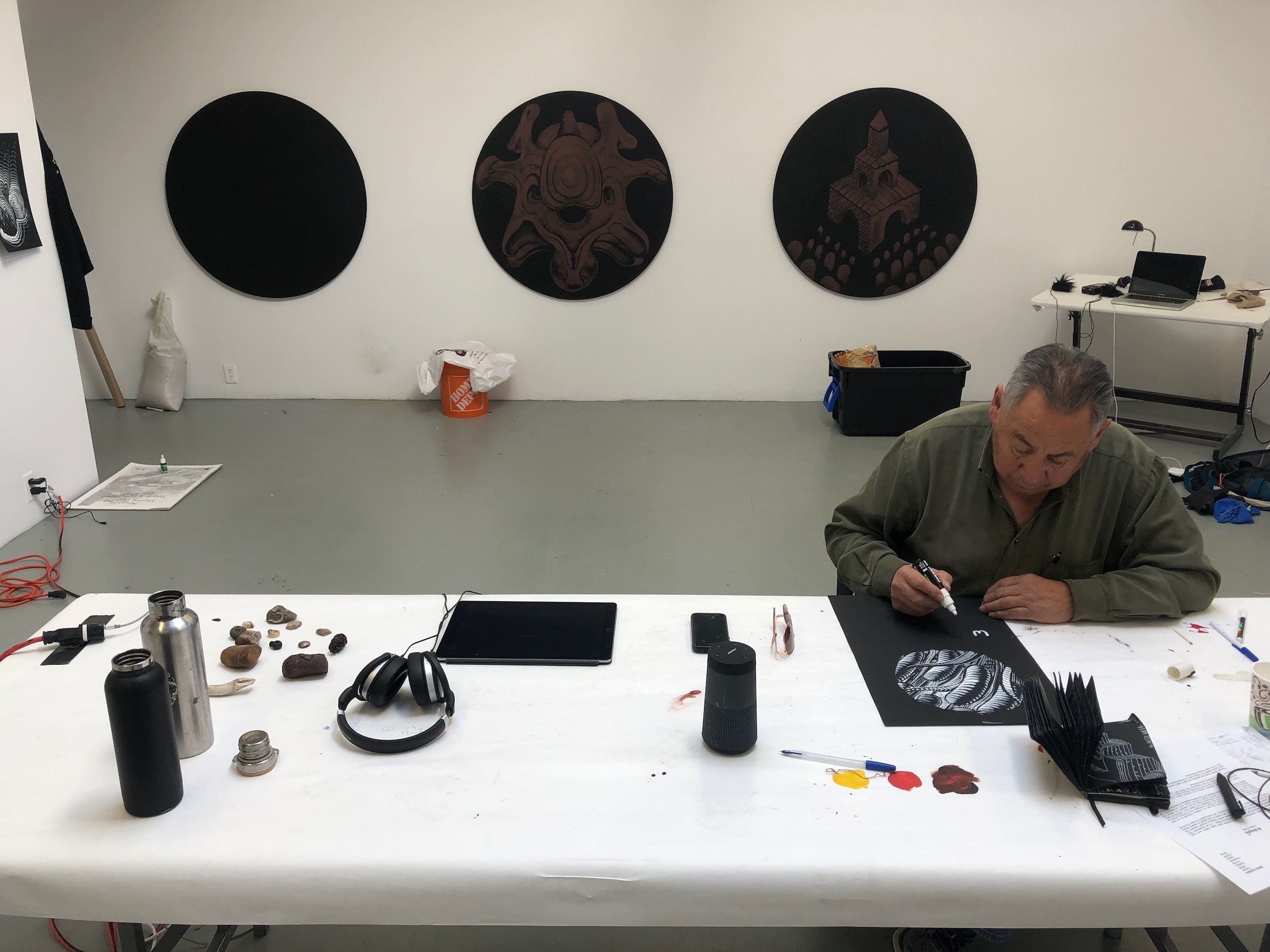
I would begin a painting. Buddy would then enter the surface with a single Stoney Nakoda word or phrase, often withholding its meaning until afterward. His intervention could change my understanding of the image in an instant.
A painting became a conversation.

Much of my time went into painting. Buddy’s contributions arrived through language, stories, music, humour and timing. We brought different kinds of work to the collaboration, and neither of us could determine its meaning alone.
There were tensions and misreadings. Some assumptions softened as we worked; others remained unresolved.
During the residency, Buddy, Dawn and I organized a visit bringing Elders from Morley to Banff Centre. Some were visiting for the first time, despite living relatively nearby. The warmth of the encounter stayed with me, as did the distance it revealed between an institution and its neighbours.

Anâraptâ — Listen to Me
This is Buddy’s ear.
I painted it first. Buddy then wrote across the surface, changing the work completely. Anâraptâ is an intimate request: listen to me.
It became the central instruction of the residency.

Iyebi — Them
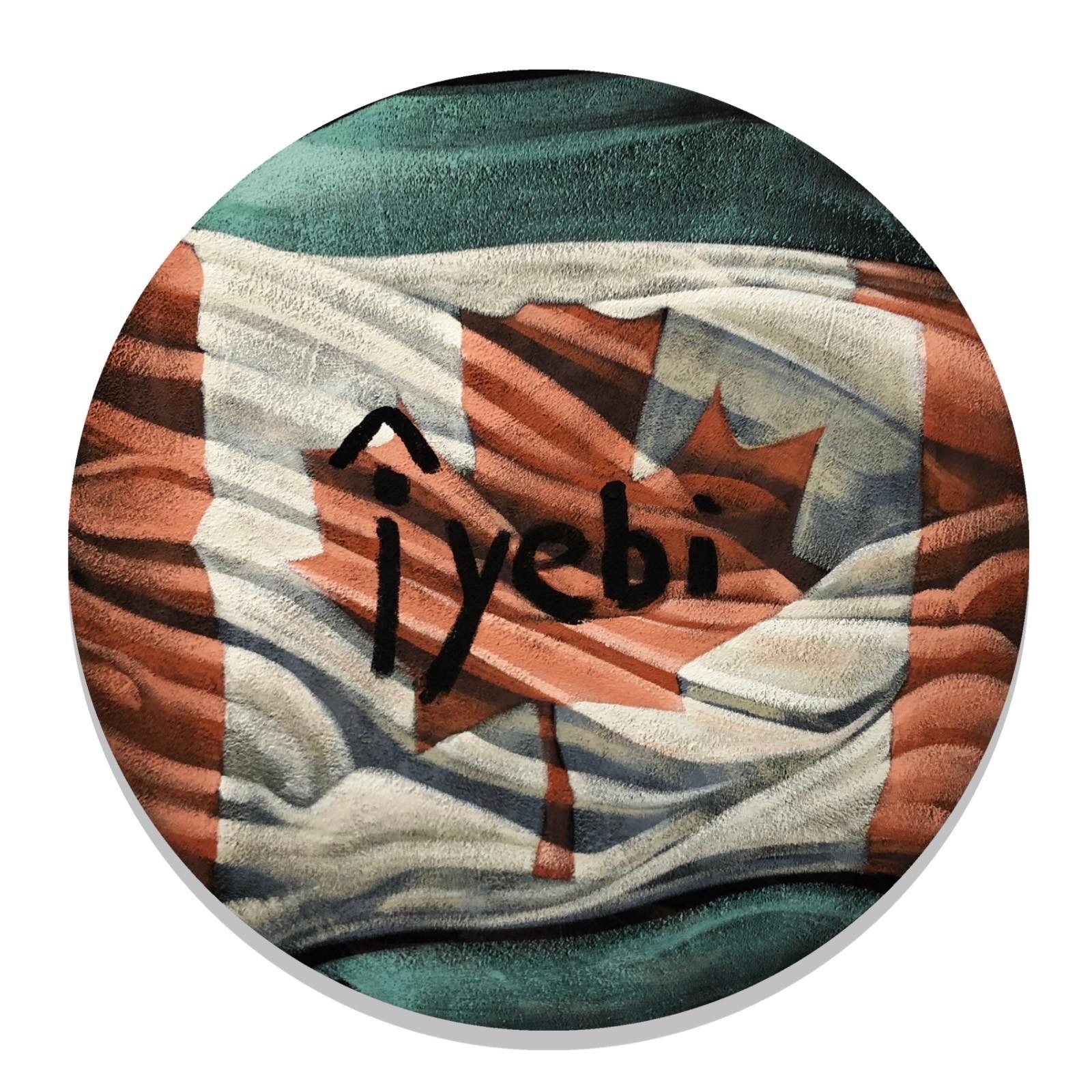
A Canadian flag can stir pride, but not everyone meets it from the same history.
Buddy entered this image with a single word: Iyebi—Them.
For the studio showing, we installed the painting at the end of a long, narrow room, partially blocked by barbed wire we had cut from the original reserve line on his land in Morley. Tables of food and drink stretched toward it.
Visitors were welcomed into the room. The flag remained beyond the wire.
Wathûgitabi — Preparing for the Harvest
This painting began with a pinecone I gathered while wandering the region.
Buddy’s intervention connected it to teachings about the squirrel preparing for winter: paying attention, gathering what is needed and preparing for what lies ahead.
A small, familiar object opened into a lesson about survival.

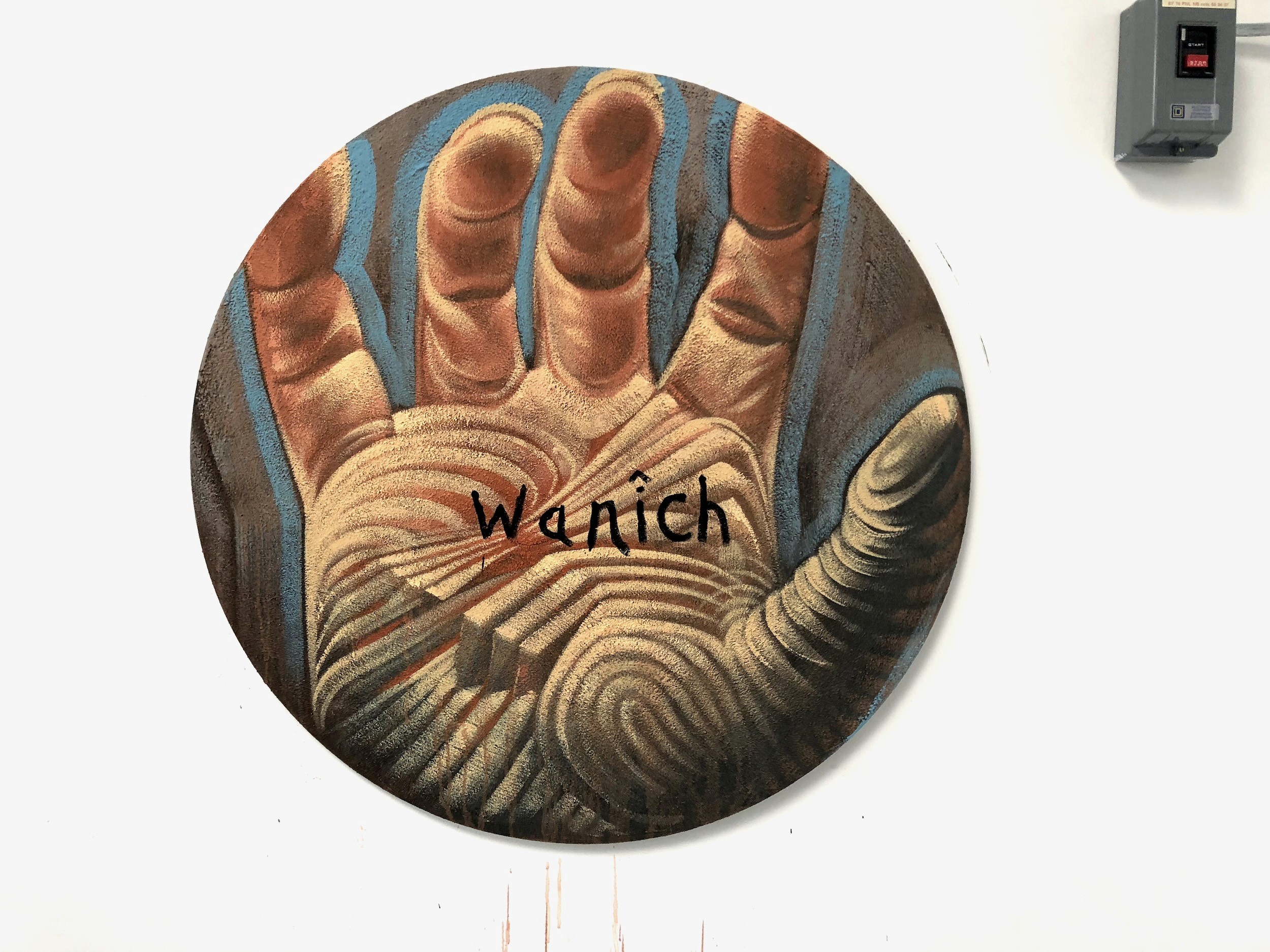
Wanîch — Saved
This is Buddy’s hand.
The word he brought to the painting—Wanîch, Saved—raised a difficult question: what does it mean to be “saved”?
We were working near places where residential schools had sought to erase Indigenous names, languages and identities, often in the name of salvation. Buddy’s word brought that history into the image through the language those institutions had tried to suppress.
Châkathnude — Cord of Life
This work began with bone weathered by Alberta sun and Chinook winds, the living tissue long gone.
The cord of life runs through the spine. Looking at what remained, I thought about the structures that hold us together—and what it might mean to bring life back to something weathered.

Wakâsatâga — Matriarch
This portrait depicts a Stoney Nakoda Elder whose face, to me, held humour, melancholy, tenderness and strength.
I cannot say for certain whether she liked the painting.
She did, however, hit me in the leg with her cane when she saw it.

Yowî îchi chiyabi — These Mountains
In this work, I approached the mountains as a presence within the relationships taking shape around us.
I was thinking about belonging: how a place holds memory, how it shapes identity, and what responsibilities come with living there.

Anâraptâ remains one of the most transformative collaborations I have experienced.
Listening asked me to stay with words I did not yet understand, to let another person change the meaning of an image I had made, and to continue working when agreement was uncertain.
We had a month in which to know one another more closely. The paintings carry something of that encounter.
© Jason Botkin