
Projects
2024 · ZAC Île-de-France
Laon, France
Commissioned by He(ART)4ALL and led by Valérie Etesse, this project brought Montreal artist ANKH1 and me to Place Jacques Prévert, in Laon’s Île-de-France district, to paint with more than thirty residents.
People arrived with different abilities, ideas and reasons for being there. Some stopped out of curiosity, while many stayed for hours. All were invited to join.
“I can’t draw” was the beginning of most conversations and, fortunately, generally not the end.

There was no application process or expectation of skill.
Children painted alongside parents, teenagers alongside retirees. Some contributed elaborate drawings. Others offered words, names, memories or a few marks.
As more people joined, the work grew beyond the original wall. Local organizers and municipal partners helped open additional surfaces around the community centre, much to the excitement of the many young people who wanted to push paint around with a stick on walls, without getting in trouble.
Over roughly thirty-two hours of painting, those contributions began to occupy a substantial part of the zone.

For much of the early process, the walls looked chaotic.
People worked simultaneously, at different scales and speeds. Images overlapped, compositions wandered, and the relationship between one contribution and the next became… far from obvious.
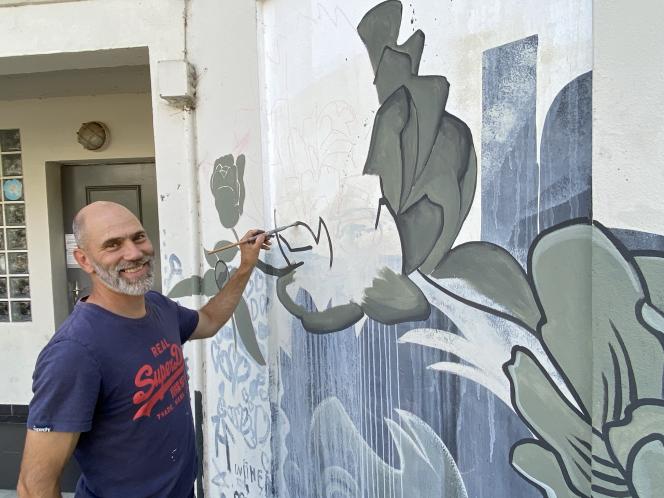
This is a familiar challenge to all who know collaborative work. It can be difficult to trust, particularly when you are watching something develop without knowing where it’s going.
Our work—especially for ANKH1 and me—was to connect the dots, helping one person’s mark find room beside another’s.
Gradually, with patience and the curiosity that comes with play, the walls began to hold together. Scattered contributions became a composition without everyone having to paint alike.

Homes kept appearing.
Buildings, apartments, courtyards and streets—places people encounter every day. Without being asked to follow any theme, residents—especially children—repeatedly returned to where they lived.
Look closely at how the neighbourhood appears on its own walls, through the choices of people who knew it best.

A father and son sat side by side, collaborating on the same section of wall for hours—even in the midday heat.
A three-year-old child (Arthur) gave nearly an entire afternoon to one patch of surface, completely absorbed, while his mother worried aloud that he didn’t know how to paint, apologizing profusely.
People who had never considered themselves artists could find their contributions within the larger work. A mark might seem modest to someone passing by while holding an entire afternoon for the person who made it.
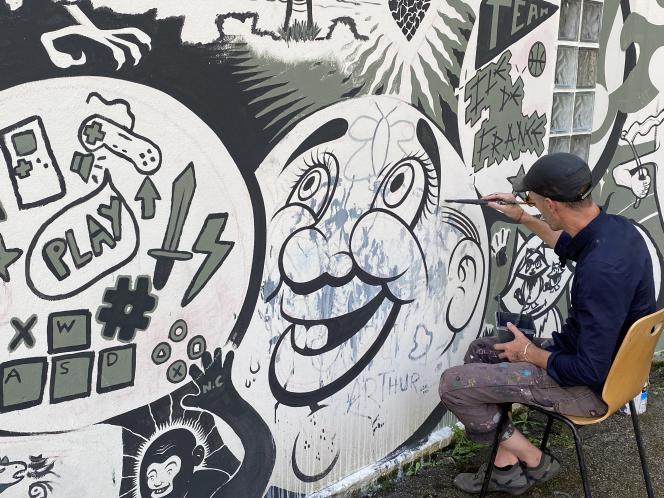
The finished painting is uneven in ways that reflect how it was made. Different hands remain visible—some passages are intricate; others are bold and energetic.
Range is the secret sauce. Bringing it together requires tuning into what others are doing without smoothing away every difference.
Participation also changes what someone can recognize in a wall. Alongside the image, there is the memory of making it, the person who painted nearby, the conversation that happened while a brush was in hand.
Whether that grows into lasting care for the place takes time to discover. Now, when the folks on that block look at the wall, they can find an asymmetrical portrait of themselves—and a neighbourhood with room for the people who made it.
© Jason Botkin